PART 2
The doctor stopped short when he saw me.
For half a second, nobody spoke.
He was a thin man in his late fifties, with silver hair, tired eyes, and the kind of controlled panic that trained professionals only showed when something had gone badly wrong behind closed doors.
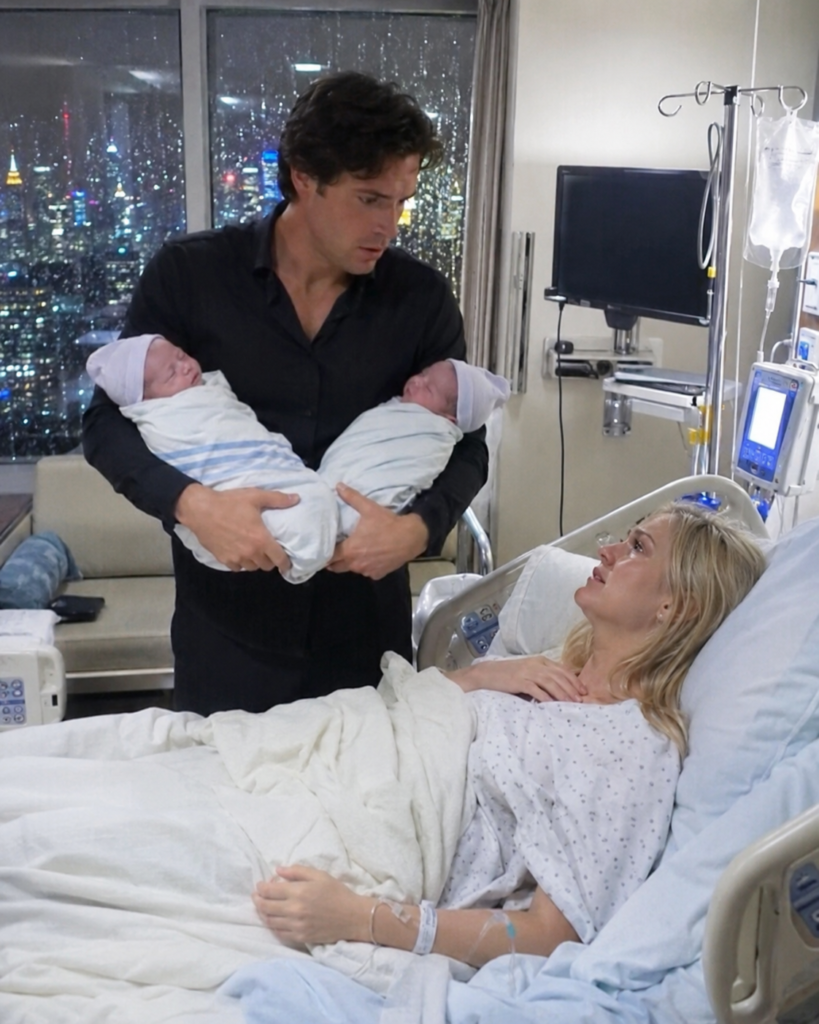
His gaze went first to Sylvie.
Then to the twins in my arms.
Then to me.
“Mr. Vexley,” he said, breathless. “I’m Dr. Adrian Kell. I need to speak with you both immediately.”
Sylvie’s face changed.
Not fear exactly.
Recognition.
Dread.
“What happened?” she asked.
Dr. Kell closed the door behind him and lowered his voice.
“There was an unauthorized request made for the infants’ discharge documentation.”
My arms tightened instinctively around the babies.
“What does that mean?” I demanded.
“It means someone tried to access their medical records before they were formally entered into the hospital system.”
“Who?”
The doctor hesitated.
That hesitation was a mistake.
I had built an empire by reading silences. In boardrooms, courtrooms, and congressional hearings, men had lied to me in expensive suits. They always betrayed themselves before their words did.
Dr. Kell was afraid.
Not of me.
Of what he had to say.
“The request came through a legal office,” he said. “Attached to a petition for emergency guardianship.”
Sylvie shut her eyes.
I turned toward her.
“You knew.”
Her lips parted, but no words came.
The baby in my left arm stirred, making a soft, fragile sound. The sound cut through my anger like a blade through silk.
I looked down.
She was so small.
Too small for all the ugliness already circling her life.
When I looked back up, my voice was quiet.
“Who is trying to take my children?”
Dr. Kell’s fingers tightened around the folder.
“The petition names Mr. Conrad Vale.”
For a moment, the name meant nothing.
Then memory surfaced.
Conrad Vale.
My former chief legal strategist.
A man with a face made for sympathy and a soul made for loopholes.
He had left Vexley Pharmaceuticals eleven months ago after I discovered he’d been feeding information to a competitor. I never proved it. Not enough to bury him in court. But I knew.
PART 3 — THE GRANDMOTHER AT THE DOOR
My mother had always known how to enter a room like a verdict.
Even from twenty floors above the lobby, I could feel her presence crawling through the hospital walls.
Vivienne Vexley was not loud. She did not need to be. She had built her life around silence, polish, and the terrifying patience of a woman who never raised her voice because she had trained everyone else to lower theirs.
Sylvie’s hand tightened around mine.
For seven months, we had been divorced.
For years before that, we had been strangers pretending to share a life.
But in that moment, with Elian and Mira crying between us, we were no longer ex-husband and ex-wife.
We were parents.
And something ancient had awakened in both of us.
“Do not let her up here,” Sylvie whispered.
“I won’t.”
But my voice sounded too calm, even to me.
Rafael was already at the door, speaking low into his phone. Dr. Kell stood pale beside the bassinets, looking like a man who had accidentally wandered into a war between old money and newborn blood.
My phone buzzed again.
Another message.
I gave you everything, Damon. Do not embarrass me in public.
I stared at the words until they blurred.
Then I typed back one sentence.
You are not coming near my children.
Three dots appeared.
Then vanished.
Then appeared again.
Finally:
They are not yours to protect. They are yours to surrender.
Something in me went cold enough to become clear.
I handed the phone to Rafael.
“Trace it.”
He nodded.
Sylvie watched me. Her face was exhausted, but her eyes were alive with fear and fury.
“She thinks she owns them,” she said.
“No,” I replied. “She thinks she owns me.”
A knock came at the door.
Everyone froze.
Rafael opened it only a few inches.
A security supervisor stood outside. Behind him, the hallway was suddenly crowded—hospital staff, two police officers, and a woman in cream cashmere with silver hair pinned perfectly at the nape of her neck.
My mother.
Vivienne did not look like a woman who had rushed through a storm. Her coat was dry. Her pearls were straight. Her lipstick was flawless.
Her eyes moved past Rafael and found mine through the gap in the door.
“Damon,” she said softly. “Move.”
One word.
A lifetime of obedience attached to it.
For a sickening second, I was a boy again.
Then Elian cried.
The sound cut the leash.
“No.”
Vivienne’s expression did not change, but her eyes sharpened.
“I am their grandmother.”
“You are a stranger.”
Sylvie sucked in a breath behind me.
Vivienne finally looked at her.
“My dear Sylvie,” she said. “You look unwell.”
Sylvie’s chin lifted.
“I just gave birth to twins while running from your lawyer. Forgive me if I didn’t dress for company.”
A flash of something almost amused crossed Vivienne’s face.
“I see motherhood has made you theatrical.”
“No,” Sylvie said. “Motherhood made me dangerous.”
The hallway went silent.
For the first time in my life, I saw my mother blink first.
Then Conrad Vale stepped into view behind her.
He wore the same charcoal coat from earlier, but now his smile had returned.
“Mr. Vexley,” Conrad said, “this doesn’t need to become unpleasant.”
“It already is,” I said.
Vivienne lifted a folder.
“We have documentation establishing immediate concern for the infants’ welfare.”
“Forged concern,” I replied.
A police officer shifted uncomfortably.
Vivienne noticed. Of course she did.
She turned to him with a wounded, dignified expression.
“My son is under extreme emotional distress. His former wife concealed a pregnancy, delivered prematurely, and has been moving between unknown locations for months. I am only asking that the children be placed under neutral protection until the court reviews the facts.”
Neutral protection.
Meaning her house.
Her staff.
Her lawyers.
Her cages.
Sylvie stepped carefully out of bed.
Dr. Kell moved toward her. “Mrs. Vexley, you shouldn’t—”
“I’m standing,” she said.
Her legs trembled, but she rose.
A hospital blanket was wrapped around her shoulders. Her hair was loose. Her face was pale. She looked fragile enough to break.
But when she walked to the door, carrying Mira against her chest, she looked more royal than Vivienne ever had.
“These are my children,” Sylvie said. “I carried them. I protected them. I bled for them. You do not get to call yourself their shelter after becoming their storm.”
Vivienne’s gaze lowered to Mira.
For one brief second, something strange passed across my mother’s face.
Not love.
Recognition.
Hunger.
“She has your father’s eyes,” Vivienne whispered.
I stepped in front of Sylvie.
“You don’t get to look at her.”
Vivienne’s attention returned to me.
“You have no idea what your father built.”
“I know what he left.”
“No.” Her voice hardened. “You know what I allowed you to inherit.”
That was when Martin Cho arrived.
He came fast, tie crooked, rain on his glasses, two junior attorneys behind him carrying sealed folders.
“Mrs. Vexley,” Martin said to my mother, not Sylvie. “Step away from the recovery room.”
Vivienne smiled faintly.
“Martin. Still loyal to whoever pays you most recently?”
Martin did not flinch.
“Still loyal to signed law. Which is more than I can say for everyone in this hallway.”
Conrad’s eyes narrowed.
Martin lifted a document.
“Court-certified expedited paternity testing has been initiated. Hospital affidavits confirm both parents are present and consenting. Any emergency petition based on abandonment or unknown paternity is defective before filing.”
Conrad’s jaw tightened.
Vivienne turned to him.
A glance.
Tiny.
Deadly.
Conrad swallowed.
I saw it.
So did Rafael.
My mother was not using Conrad.
She was controlling him.
But beneath that control, he was afraid of her.
That mattered.
Vivienne looked back at me.
“You are making this difficult because you are emotional.”
“Yes,” I said. “For once, I am.”
Her face cooled.
“Your father was emotional too. It killed him.”
The hallway vanished.
My chest tightened.
“What did you say?”
Vivienne’s lips parted.
Perhaps she had not meant to say it.
Perhaps anger had loosened something old and buried.
Rafael turned slowly toward her.
Martin went still.
Sylvie’s hand found my arm.
Vivienne recovered instantly.
“I said weakness killed him.”
“No,” I said. “You said emotion did.”
Conrad shifted.
My mother noticed too late.
Rafael stepped forward.
“Mrs. Vexley, where were you the night Alistair Vexley died?”
Vivienne’s eyes sliced toward him.
“You work for my son. Do not mistake yourself for family.”
Rafael smiled without warmth.
“I never do.”
For years, my father’s death had been a closed room inside me.
A heart attack, they said.
Sudden.
Private.
Convenient.
I had been twenty-seven, newly crowned, too buried under grief and corporate collapse to ask the questions that might have saved me from a decade of lies.
Now my mother stood outside the maternity ward, and the past had cracked open.
Vivienne lowered her voice.
“Damon, let me see the children. Then we can discuss this privately.”
“No.”
Her eyes flicked to the twins.
“This is bigger than your pride.”
“It has nothing to do with pride.”
“Everything with you is pride.”
“No,” I said. “Pride lost me Sylvie. Pride kept me from knowing my children existed. Pride made me easy for you to manipulate.”
I stepped closer to the doorway.
“But this? This is not pride.”
Elian whimpered in the bassinet behind me.
I looked at my mother.
“This is love.”
For the first time, Vivienne Vexley looked disgusted.
“Then you have already lost.”
She turned and walked away.
Conrad hesitated, staring at me.
Then he leaned close enough for only me to hear.
“She won’t stop. And when she burns you, remember I offered a legal solution.”
I smiled.
“You should run before she decides you know too much.”
His face changed.
A small crack.
Fear.
Then he followed her down the hall.
The police officers looked relieved to leave. Hospital staff scattered. The door closed.
And the room became quiet again.
Too quiet.
Sylvie leaned against the bed, trembling.
I reached for her.
She did not pull away.
“Damon,” she whispered, “what did your mother mean about your father?”
I looked down at our sleeping children.
For the first time in fifteen years, I allowed myself to say the thing I had never dared think.
“I don’t know how my father died.”
Martin closed the blinds.
Rafael locked the door.
And somewhere beneath the hospital, Vivienne Vexley was already making her next move.
PART 4 — THE TRUST THAT WAS WRITTEN IN BLOOD
By noon, Mount Sinai Hospital had become a fortress pretending to be a hospital.
Rafael’s men were posted at every elevator. Martin had filed emergency protections before Conrad could poison the court record. Dr. Kell moved the twins’ medical files into restricted access.
And Sylvie slept for exactly eleven minutes before waking in panic.
“Where are they?”
I stood immediately.
“Here.”
Elian and Mira were sleeping side by side in their bassinets beneath the window.
Sylvie’s breathing slowed only when she saw them.
I understood then that fear had rewired her body. For months, she had lived as prey. Every silence had meant danger. Every stranger had become a possible thief. Every closed door had been a trap.
I sat beside her bed.
“No one took them.”
She looked at me.
“Not yet.”
The words cut deeper than accusation.
Martin entered with a stack of files and the expression of a man who had not slept and had discovered the world was worse than expected.
“We found the original trust reference,” he said.
I stood.
Sylvie pushed herself higher against the pillows.
Martin placed the documents on the table.
“Your father created two versions. The public trust instrument—the one we’ve operated under for years—and a sealed private codicil. The public document gives future heirs protected equity at adulthood. But the codicil…”
“At birth,” I said.
Martin nodded.
“Control is held by a parental guardian until the heirs reach twenty-five. Not the company. Not the board. Not Vivienne.”
Sylvie went still.
“So if someone controls Elian and Mira…”
“They control their voting rights,” Martin said. “And through those rights, a blocking position in Vexley Pharmaceuticals.”
I looked at my children.
They were less than a day old.
And already people had placed crowns over their cribs.
“Why would my father do that?” I asked.
Martin hesitated.
“Because he did not trust your mother.”
Silence fell.
Then Martin slid another paper forward.
“This was attached to the codicil.”
It was a letter.
My father’s handwriting.
Strong. Slanted. Familiar enough to hurt.
My hands did not move.
Sylvie noticed.
“Damon?”
“I haven’t seen his handwriting in years.”
She reached over, took the letter, and placed it gently into my hands.
I opened it.
My son,
If you are reading this, then either I failed to tell you the truth in life, or Vivienne succeeded in burying it after my death.
The room blurred.
I kept reading.
The company was never meant to be a throne. It was meant to be a shelter. Your mother believes blood is ownership. She is wrong. Blood is responsibility. If you have children, protect them from the hunger of our name. Protect them even from me, if memory makes me look kinder than I was.
I stopped.
My throat had closed.
Sylvie’s hand covered mine.
I forced myself to continue.
The codicil gives your children power at birth because Vivienne would never expect me to trust infants more than I trusted her. Their guardian must be chosen by both living parents. If those parents are divided, the court must appoint an independent protector—not a Vexley family member.
Martin spoke softly.
“That clause is why Vivienne needs Sylvie declared unfit and you emotionally unstable. If both of you are discredited, she can argue herself into the protector role.”
Sylvie’s face went pale.
“She planned everything.”
“No,” Rafael said from the corner. “Not everything.”
We looked at him.
“She did not plan Damon believing you.”
Sylvie looked at me.
Something fragile passed between us.
Belief.
Late, imperfect, but real.
My phone rang.
Unknown number.
Rafael nodded for me to answer.
I put it on speaker.
“My son,” Vivienne said.
Sylvie closed her eyes.
“What do you want?” I asked.
“To prevent you from ruining your life over a woman who abandoned you.”
Sylvie flinched.
I said, “Careful.”
Vivienne ignored it.
“You think this is romance because you are frightened. But when the babies cry for six months, when she resents you, when the press discovers she hid heirs worth billions, you will remember who knew you best.”
“You never knew me.”
“I made you.”
“No. You trained me.”
A pause.
Then she laughed softly.
“Fine. Let us be honest. Sylvie will never forgive you. You will never trust her fully. Those children will become weapons between you. I am offering stability.”
“You are offering captivity.”
“I am offering legacy.”
I looked at Sylvie.
She was staring at the twins.
“No,” I said. “You are offering the same cold room you raised me in.”
Vivienne’s voice changed.
“Your father wanted to give everything away.”
The words landed like thunder.
“What?”
“He had become sentimental. Weak. He wanted to restructure the company into a public benefit foundation. Imagine it, Damon. Your empire handed to committees, doctors, charity boards. He would have destroyed the Vexley name.”
Martin went still.
Rafael’s eyes sharpened.
“You stopped him,” I said.
“I preserved what was ours.”
“How?”
Silence.
Then Vivienne said, “Do not ask questions you cannot survive.”
Sylvie whispered, “Damon…”
I barely heard her.
“My father did not die of a heart attack, did he?”
Vivienne sighed.
“Your father died because he forgot what power requires.”
The line disconnected.
No one moved.
Then Martin said, very quietly, “That sounded like a confession.”
Rafael was already on his phone.
“Recorded?”
“Every word,” Rafael said.
But I was not celebrating.
I felt hollow.
All these years, I had mourned a ghost with the wrong story.
Sylvie swung her legs carefully over the bed.
I turned.
“What are you doing?”
“Coming with you.”
“No.”
Her eyes flashed.
“Do not start commanding me now.”
“You just gave birth.”
“And you just found out your mother may have killed your father. Neither of us is in ideal condition.”
Despite everything, Martin almost smiled.
I did not.
“Sylvie—”
“She hunted me because I was alone,” Sylvie said. “I will not be alone again.”
Mira stirred.
Sylvie looked down and softened instantly.
“But they come first.”
Rafael stepped forward.
“They need a secure location. Hospital is compromised. Your mother knows the room, the staff, the legal timeline.”
“Where?” I asked.
Rafael hesitated.
“There is one place Vivienne won’t expect.”
I already knew.
“No.”
Sylvie looked between us.
“What place?”
Rafael answered before I could stop him.
“Your father’s old house in the Hudson Valley.”
I stared at him.
“Nobody goes there.”
“Exactly.”
Sylvie frowned.
“What house?”
I looked at her.
“The house where I grew up before my mother decided Manhattan looked better in photographs.”
Rafael said, “It’s still maintained through a blind property service. Not under current Vexley corporate accounts. Security can be locked down.”
Martin nodded. “Legally, discharge can be arranged under medical transport if Dr. Kell approves. We keep the court filings moving while Vivienne thinks you’re still here.”
Sylvie looked at me.
“Why don’t you want to go there?”
Because that house held my father’s absence in every room.
Because my mother had erased him from our lives but not from those walls.
Because I had not stepped inside since the funeral.
I looked at my newborn children.
“Because ghosts live there.”
Sylvie reached for my hand.
“Then maybe it’s time they told the truth.”
That evening, under gray skies and relentless rain, we left the hospital through a service corridor.
Sylvie was pale but steady in a wheelchair, Mira in her arms. I carried Elian beneath my coat, absurdly afraid of the cold touching him. Rafael led us through doors that smelled of bleach and steam.
At the ambulance bay, an unmarked medical van waited.
As the doors opened, my phone buzzed one last time.
A message from Vivienne.
Run if you like. I know every place you have ever belonged.
I looked at Sylvie.
Then at the babies.
Then at the city behind us.
For the first time in my life, I did not feel like I was running away.
I was running toward the truth.
PART 5 — THE HOUSE WHERE MY FATHER HID THE TRUTH
The Hudson Valley house stood at the end of a road swallowed by wet trees.
It was larger than I remembered and lonelier than it had any right to be. Stone walls, black shutters, ivy crawling along the east wing like fingers. The windows reflected the storm clouds, turning the whole place into something half mansion, half mausoleum.
Sylvie stared through the van window.
“You grew up here?”
“Until I was twelve.”
“It looks haunted.”
“It is.”
She looked at me.
“By your father?”
“No,” I said. “By what happened after he left.”
Rafael’s team cleared the house before we entered. Every room. Every closet. Every old servant corridor and locked storage cellar. The twins slept through it all, unimpressed by ancestral drama.
Inside, the house smelled of lemon oil, old wood, and rain.
The entry hall still had the black-and-white marble floor where I had once slipped as a child and split my chin. My father had carried me to the kitchen laughing while my mother scolded the blood for staining my shirt.
I had not remembered that until I stepped inside.
The memory hurt.
Sylvie noticed, but said nothing.
That was one of the things I had once loved about her. She understood silence not as emptiness, but as space.
Dr. Kell had arranged a private neonatal nurse, a calm woman named Ruth who treated billionaires, bodyguards, and family conspiracies with the same unimpressed practicality.
“Babies need feeding, warmth, clean diapers, and calm adults,” Ruth announced. “Try to provide at least two of those consistently.”
Sylvie laughed.
Actually laughed.
The sound moved through the old house like sunlight entering a sealed room.
For two hours, life became strangely ordinary.
Mira refused to settle unless Sylvie hummed. Elian sneezed three times and made me panic. Ruth taught me how to change a diaper while Rafael pretended not to watch me fail.
“You built a pharmaceutical empire,” Sylvie said, leaning against the nursery doorframe.
“This child has more tactical skill than most hostile investors.”
“He is two days old.”
“Exactly. No predictable patterns.”
She smiled.
It was brief.
But real.
The nursery had once been mine.
Someone had covered the old furniture with sheets. Rafael’s team removed them, revealing a carved wooden crib, a rocking chair, a faded blue rug with tiny silver stars.
Sylvie touched the crib rail.
“Yours?”
“Yes.”
She looked around.
“Your mother kept it?”
“My father did.”
“How do you know?”
Because tucked into the corner of the crib was a tiny brass plate.
For Damon,
so he may dream without fear.
—Father
I had never seen it before.
I turned away.
Sylvie’s voice softened.
“He loved you.”
I swallowed.
“I don’t know what he knew how to love.”
“Maybe none of us do at first.”
That sentence stayed with me.
Near midnight, Rafael found the hidden room.
It happened because Elian would not stop crying.
Ruth said he was gassy. Sylvie said he wanted warmth. I decided he wanted a formal apology from the entire Vexley bloodline.
I carried him through the upstairs hallway, rocking him badly but earnestly. His tiny face was red with outrage.
“I agree,” I whispered. “The accommodations are unacceptable.”
A floorboard creaked beneath my foot.
Not unusual in an old house.
But then the wall beside my father’s old study clicked.
I froze.
Elian stopped crying.
For one absurd second, we stared at each other as if he had done it.
Then the panel opened half an inch.
“Rafael,” I called.
Within minutes, the hidden door was fully open.
Behind it was a narrow staircase descending into darkness.
Sylvie arrived wrapped in a robe, Mira against her shoulder.
“You found a secret passage while burping a baby?”
“Elian found it.”
Sylvie looked at our son.
“Of course he did.”
Rafael went first.
Then me.
The stairway led to a small underground room beneath the study. Dry, sealed, windowless. A desk sat against one wall. Metal cabinets lined another. There was an old tape recorder, banker’s boxes, photographs, and a safe.
On the desk lay an envelope.
My name was written across it.
Not by my mother.
By my father.
My hands went numb.
Sylvie came down behind me despite everyone telling her not to. She did not touch me. She simply stood close enough that I could feel her there.
I opened the envelope.
Inside was a cassette tape and a note.
Damon,
If this room is found, then either my grandchildren exist, or your mother has finally forced the truth into daylight. I am sorry I did not protect you better. But I may still protect what comes after you.
Rafael found an old player.
The tape hissed.
Then my father’s voice filled the room.
Older than memory.
Closer than death.
“Damon,” he said, “if you are hearing this, forgive me.”
I sat down hard in the chair.
The recording continued.
“I married your mother believing ambition was a form of strength. I was wrong. Ambition without love becomes appetite. By the time I understood that, she had learned every weakness in the company, every weakness in me, and most painfully, every weakness in you.”
Sylvie’s hand covered her mouth.
My father breathed shakily on the tape.
“I discovered Vivienne had been moving assets through dormant subsidiaries. She was preparing to seize control if I changed the trust. I intended to remove her from all company influence and convert controlling shares into a medical access foundation.”
Martin, who had joined us by then, whispered, “God.”
My father continued.
“She found out. After that, I began to feel ill. Small things. Dizziness. Weakness. I suspected poisoning but could not prove it quickly enough.”
The room disappeared beneath me.
Sylvie gripped my shoulder.
“I have left documentation here. Lab reports. Samples. Names. If I die before I speak publicly, do not confront her alone. She is most dangerous when cornered.”
The tape clicked.
A long pause.
Then my father’s voice softened.
“And Damon… I know I failed you by staying silent. Your mother taught you power because I did not teach you tenderness loudly enough. I hope one day someone does. I hope, when that day comes, you are brave enough not to punish them for it.”
The tape ended.
No one spoke.
Then Mira cried upstairs.
Softly.
Hungry.
Alive.
Sylvie whispered, “He left this for you.”
“No,” I said, staring at the wall of evidence.
“He left it for them.”
Rafael opened the safe using a code hidden in the note.
Inside were medical reports, correspondence with investigators, financial ledgers, and one final sealed packet marked:
VIVIENNE — CONFESSION CONTINGENCY
Martin opened it with gloved hands.
Inside was not a confession.
It was worse.
Photographs.
Vivienne meeting with Conrad Vale years ago.
Before Conrad worked for me.
Before my father died.
Before any of this had supposedly begun.
Conrad had never become my enemy.
He had always been my mother’s weapon.
And in the last photograph, a much younger Liana Pierce stood beside them.
Sylvie looked at it.
“She was involved even then?”
Rafael’s jaw tightened.
“She was placed near Damon.”
I stared at Liana’s young face.
Six years of loyalty.
Six years of schedules and secrets.
Six years of my life quietly reported back to my mother.
My phone rang.
This time, it was a video call.
From Vivienne.
Rafael said, “Don’t answer.”
But I did.
My mother appeared on-screen, seated somewhere elegant, dimly lit, a glass of water beside her.
She smiled.
“So you found the room.”
My blood went cold.
Sylvie whispered, “She knew.”
Vivienne’s smile widened.
“Of course I knew. Your father was sentimental, not clever.”
I looked at the boxes around me.
“You left the evidence?”
“No,” she said. “I left the bait.”
Behind her, someone moved.
A woman stepped into view holding a baby blanket.
Not just any blanket.
The yellow blanket from Sylvie’s hospital room.
Sylvie gasped.
Vivienne leaned closer to the camera.
“You have my documents, Damon. I have something better.”
The camera shifted.
A live feed appeared.
The nursery upstairs.
Elian and Mira sleeping.
From inside the room.
Rafael turned and ran.
Vivienne whispered through the phone:
“You brought them exactly where I wanted.”
PART 6 — THE NIGHT THE NURSERY WENT DARK
I have known fear in many forms.
Market collapse.
Federal raids.
A gun pressed against my ribs during a kidnapping attempt in São Paulo.
But nothing compared to watching my children sleep through a camera controlled by my mother.
Sylvie screamed their names and ran.
She should not have been able to move that fast. Not after childbirth. Not after blood loss. Not with exhaustion hollowing her bones.
But terror gave her wings.
I followed.
Rafael reached the nursery first.
The door was open.
The bassinets were empty.
For one second, my mind refused to understand what my eyes saw.
Empty.
No Elian.
No Mira.
No tiny fists.
No soft breathing.
Just two folded blankets and the blue star rug beneath them.
Sylvie made a sound that did not belong in any human throat.
Then Ruth, the nurse, staggered from the adjoining room, hand pressed to her forehead.
“They sprayed something,” she gasped. “I heard the door—then nothing.”
Rafael caught her before she fell.
I turned slowly.
There are moments in life when rage becomes useless because it is too small.
What filled me then was not rage.
It was purpose stripped of mercy.
My phone, still in my hand, showed Vivienne’s face.
She looked calm.
“Do not panic,” she said. “They are safe.”
Sylvie lunged for the phone.
“Where are my babies?”
Vivienne looked at her with faint distaste.
“You will lower your voice. Hysteria will not help your case.”
Sylvie went utterly still.
When she spoke again, her voice was quiet enough to frighten me.
“If you hurt them, I will spend the rest of my life becoming worse than you.”
Vivienne studied her.
Then, for the first time, I saw it.
My mother was not afraid of me.
She was afraid of Sylvie.
Because I had been raised inside Vivienne’s rules.
Sylvie had not.
“You will receive instructions,” Vivienne said. “Bring the evidence your father hid. Bring the original hospital DNA report. Bring Sylvie’s signed consent to temporary family protection. Come alone.”
“No,” I said.
Vivienne smiled.
“Then the court receives evidence that you staged a disappearance to manipulate trust control.”
“You kidnapped newborns.”
“Prove it.”
The line went dead.
Rafael was already tearing the room apart.
“Service corridor,” he said. “Two-person extraction. They knew the rotation. They knew our blind spots.”
Martin looked sick.
“Inside help again.”
I could not breathe.
Sylvie was standing beside the empty bassinet, one hand gripping the rail so hard her knuckles had gone white.
I approached her.
“Sylvie.”
She looked at me.
And I saw the question in her eyes.
Not accusation.
Worse.
Trust breaking under unbearable weight.
“You said they were safe here,” she whispered.
I had no defense.
So I gave none.
“I was wrong.”
The words cost me nothing compared to what she had lost.
Then she slapped me.
Hard.
The sound cracked through the nursery.
Rafael froze.
Martin looked away.
My cheek burned.
Sylvie’s hand trembled.
“I needed you to be right,” she said.
“I know.”
“I needed one person to be right.”
“I know.”
Her face crumpled.
Then she collapsed against me, and I held her while she sobbed into my shirt.
No apology would bring them back.
No vow would feed them.
No empire mattered while their bassinets sat empty.
So I did the only useful thing left.
I listened.
Rafael reconstructed the abduction within twenty minutes.
The kidnappers had entered through an old servants’ tunnel connected to the east greenhouse. The tunnel had been sealed on modern blueprints but still physically passable. Someone with historical knowledge of the house had directed them.
Vivienne.
They had used a short aerosol sedative against Ruth, avoided cameras, and left through the same tunnel into the storm.
But they made one mistake.
Elian.
In my panic, I had forgotten the tiny hospital bracelet Dr. Kell insisted remain on his ankle for tracking medical identity and discharge verification. It had a passive chip. Short range, not GPS.
But Rafael had upgraded security around the twins before we left Mount Sinai.
“Not GPS,” he said, typing rapidly. “But the bracelet pinged when passing a toll reader on the private road.”
“Where?”
His eyes lifted.
“North.”
Sylvie wiped her face.
“How far?”
“Twenty-three minutes ahead.”
“Then we go.”
Martin grabbed my arm.
“Damon, Vivienne wants you reactive.”
“No. She wants me alone.”
I looked at Rafael.
“So I won’t be.”
Within ten minutes, we were in three vehicles moving without headlights through rain-black roads.
Sylvie sat beside me in the back of Rafael’s SUV.
She had refused to stay behind.
No one argued after seeing her face.
In her lap sat the yellow hospital blanket Vivienne’s accomplice had left behind. Sylvie gripped it like a relic.
I called Liana.
She answered sobbing.
“Damon?”
“Where would my mother take newborns?”
“I don’t know.”
“Wrong answer.”
“I swear—”
“Sylvie is listening.”
Silence.
Then Liana whispered, “There is a property. Not hers officially. An old retreat near Cold Spring. Your father bought it for someone.”
My head turned.
“For whom?”
Liana hesitated.
“Your half-brother.”
The SUV seemed to drop beneath me.
Sylvie stared.
“My what?”
Liana cried harder.
“His name is Gabriel. Vivienne erased him from the family records. He was your father’s first son.”
Every word rewrote my life.
“My father had another child?”
“Yes. Before Vivienne. Gabriel’s mother died. Your father wanted to bring him into the family. Vivienne refused. After your father died, Gabriel disappeared from every legal structure.”
Martin’s voice came through the car speaker from the vehicle behind us.
“That explains the codicil. Alistair knew Vivienne would erase heirs who threatened her control.”
I felt sick.
“Where is Gabriel now?”
Liana whispered, “With Vivienne.”
Sylvie leaned forward.
“Is he helping her?”
“I don’t know.”
But her voice said she did.
Rafael turned the SUV sharply onto a private road.
“Bracelet pinged again.”
The trees thickened.
Rain slapped the windshield.
Then lights appeared ahead.
A stone lodge stood beyond an iron gate.
No guards visible.
That was worse.
Rafael stopped the convoy half a mile away.
“We approach on foot.”
Sylvie opened her door.
“No,” I said immediately.
She looked at me.
“Do not waste breath telling a mother to wait in a car.”
So we moved through the trees together.
The rain soaked us in seconds. Branches clawed at my coat. Mud swallowed my shoes. Sylvie stumbled once, and I caught her. She shook me off, not cruelly, but because she needed every piece of herself aimed forward.
At the edge of the property, we saw the nursery window.
Light glowed inside.
A woman moved past the curtain.
Holding a baby.
Sylvie stopped breathing.
“Elian,” she whispered.
Then another figure appeared.
A tall man.
Dark hair.
Broad shoulders.
For one impossible second, I thought I was looking at myself from another life.
Gabriel.
My half-brother.
He stood at the window holding Mira.
Not roughly.
Not like a kidnapper.
He held her carefully, awkwardly, with visible wonder.
Then Vivienne entered the room.
Gabriel turned.
They argued.
We could not hear the words through rain and glass.
Then Vivienne reached for Mira.
Gabriel stepped back.
My heart slammed once.
Rafael whispered, “Something’s wrong.”
Inside, Vivienne raised her hand and struck Gabriel across the face.
He did not move.
Then he looked down at Mira.
And his expression changed.
Not fear.
Decision.
A second later, the lights in the lodge went out.
Rafael cursed.
The night exploded.
A siren shrieked from somewhere inside. Men shouted. Glass shattered.
Then the front door burst open.
Gabriel ran into the storm with both twins against his chest.
Vivienne appeared behind him screaming his name.
Not Damon.
Gabriel.
Rafael moved first.
We all ran.
Gabriel stumbled near the trees. I reached him just as he nearly fell. He looked up at me, rain streaming down a face that looked painfully like my father’s.
“Take them,” he gasped.
Sylvie reached for Mira with a broken cry.
I took Elian.
My son was warm.
Alive.
Furious.
The sound he made against my chest nearly brought me to my knees.
Gabriel looked at me.
“I’m sorry,” he said. “I didn’t know she would take them. I thought she was protecting them from you.”
Then his knees buckled.
Blood spread through his shirt.
Sylvie screamed.
Behind us, Vivienne stood at the lodge door, face white with rage.
In her hand was a gun.
She had shot her own stolen son to keep my stolen children.
And still, she called out through the rain:
“Damon, bring them back.”
PART 7 — THE SON SHE ERASED
Rafael fired once.
Not at Vivienne.
At the stone beside her head.
The shot shattered the night.
Vivienne froze.
For perhaps the first time in her life, someone had answered her command with something she could not negotiate.
“Drop it,” Rafael shouted.
Vivienne did not.
She looked at me instead.
Even in rain, even with police sirens beginning in the distance, even with Gabriel bleeding in the mud, she still believed the world might rearrange itself around her will.
“Damon,” she said, “you are making a mistake.”
I held Elian beneath my coat.
Sylvie clutched Mira to her chest, rocking and crying at the same time.
Behind me, Gabriel tried to breathe.
I looked at my mother.
“No,” I said. “I made the mistake years ago when I believed you were all I had left.”
Something flickered in her eyes.
Not grief.
Offense.
“You ungrateful child.”
Gabriel laughed weakly from the ground.
It turned into a cough.
“Join the club,” he rasped.
Vivienne’s face twisted.
“You were nothing before I gave you purpose.”
Gabriel looked at me, pain tightening his mouth.
“She told me you knew about me,” he said. “She told me you chose to erase me.”
I shook my head.
“I didn’t know.”
“I believe you now.”
Sylvie knelt beside him, still holding Mira.
“You saved them.”
Gabriel’s eyes filled with something like shame.
“Too late.”
“No,” she said fiercely. “Not too late.”
Rafael’s men surrounded Vivienne. The police arrived minutes later, then federal agents Rafael had contacted using his old channels. Vivienne did not scream when they took the gun from her. She did not struggle when they cuffed her.
She merely looked at me and said, “You will come back to me when they disappoint you.”
Sylvie stood.
Rain ran down her face, hiding tears.
“No,” she said. “He won’t.”
Vivienne smiled faintly.
“You think love makes people stay?”
Sylvie looked down at Mira, then at Elian in my arms.
“No. Love makes people choose. Every day. Even when it hurts. Especially then.”
Vivienne’s smile vanished.
They led her away.
Conrad was found inside the lodge, locked in a pantry.
That was the first surprise.
The second was that he was crying.
When Rafael pulled him out, Conrad looked less like a mastermind than a man who had sold his soul and discovered the buyer never intended to pay.
“She was going to kill me,” he said.
“Eventually,” I replied.
He gave a broken laugh.
“She killed your father.”
The whole room went still.
Gabriel, now being treated by paramedics, turned his head.
Conrad looked at the floor.
“I helped cover it up.”
Martin stepped closer.
“Say that again with counsel present.”
Conrad shook his head.
“No. I want protection first.”
Rafael smiled.
“You are standing in a room full of law enforcement after participating in the kidnapping of newborns. Protection is now something you earn with speed.”
Conrad talked.
He talked for forty-seven minutes.
He said Vivienne had suspected my father’s plan to restructure Vexley Pharmaceuticals. She had used Conrad, then a young estate attorney, to draft alternate documents. When Alistair found out, he prepared the hidden room. Vivienne panicked.
The poisoning had been subtle.
Not dramatic.
Not immediate.
A medication substitution. A slow weakening. A final induced cardiac event staged during a weekend when staff were dismissed.
Conrad had destroyed records.
Liana had been a junior clerk then, forced and frightened and later rewarded with a position near me.
Gabriel had been hidden because his existence complicated inheritance.
Vivienne had told him I hated him.
Told me nothing.
Then she waited fifteen years.
Until Sylvie became pregnant.
Until Elian and Mira awakened the original trust.
Until she saw a chance not merely to control Vexley Pharmaceuticals, but to correct what she considered my father’s final insult.
She wanted the company, the bloodline, and the story.
By dawn, Gabriel was in surgery.
The twins were back under medical care.
Sylvie refused to release them unless absolutely necessary.
I did not blame her.
In a private hospital suite under federal guard, we sat side by side, each holding one child.
Neither of us spoke for a long time.
Then Sylvie said, “You have a brother.”
“I know.”
“You nearly lost him tonight.”
“I know.”
“You nearly lost us.”
I looked at her.
That one was harder.
“Yes.”
She studied me with tired, wounded eyes.
“Damon, I cannot live inside your war.”
“I don’t want you to.”
“But war follows your name.”
“Then I’ll change what the name means.”
She looked away.
“Billionaires always say things like that when they’re emotional.”
“I’m not saying it as a billionaire.”
“No?”
“No.”
I looked down at Elian.
“I’m saying it as a man who just realized his father tried to save him and failed. I will not fail them the same way.”
Sylvie’s expression softened, but caution remained.
“And me?”
The question nearly stopped my heart.
For years, I had answered the wrong questions with money, silence, control.
This one required something I had not practiced enough.
Truth.
“I failed you already,” I said. “I can’t undo that.”
“No.”
“But I can stop pretending love is proven by winning.”
Sylvie’s eyes filled.
“I waited so long to hear something like that.”
“I know.”
“No,” she whispered. “You don’t.”
And she was right.
I did not know the full shape of her loneliness. I did not know every night she had slept with one hand over her stomach, afraid someone would come through the door. I did not know how many times she had almost called me and stopped because the memory of my coldness answered first.
But I could learn.
If she allowed it.
If I earned it.
Martin entered quietly near sunrise.
“There’s another issue.”
Sylvie laughed without humor.
“Of course there is.”
Martin almost apologized.
“The trust requires both parents to appoint a protector for the twins’ voting rights until they are twenty-five. With Vivienne disqualified, the court will ask for your nomination.”
“Not me,” I said immediately.
Martin blinked.
“What?”
“I won’t control their shares.”
Sylvie stared at me.
“Damon…”
“No. That power almost got them killed. My father made the codicil to protect children from being erased. Not to put another crown over their crib.”
Martin said, “Then who?”
I looked through the glass wall toward the surgical wing.
“Gabriel.”
Sylvie went still.
“He was part of this.”
“He was lied to,” I said. “Used. Erased. And when it mattered, he ran through a storm carrying our children away from the woman who owned his whole life.”
Martin considered this.
“The court may accept him after cooperation and review.”
Sylvie looked at Mira.
Then at me.
“I want one more condition.”
“Anything.”
“No Vexley alone controls their future. Not Gabriel. Not you. Not me.”
Martin nodded slowly.
“A three-person protector structure. Gabriel, an independent fiduciary, and one parent approval for major votes.”
Sylvie looked at me.
“And the company?”
I knew what she was asking.
Not legally.
Morally.
“What happens to the empire everyone tried to steal?”
I looked at my children.
Then at the morning light.
“My father wanted a medical access foundation.”
Martin’s brows lifted.
“That would reduce your personal control dramatically.”
For fifteen years, that sentence would have frightened me.
Now it sounded like oxygen.
“Good.”
Sylvie stared at me as if seeing me from far away, walking slowly closer.
“You would do that?”
“No,” I said.
Her face fell slightly.
Then I corrected myself.
“We would.”
She looked down at Mira.
Mira yawned.
Tiny.
Unimpressed.
Sylvie laughed through tears.
“You are asking your ex-wife to help dismantle your empire before breakfast?”
“I’ve had stranger mornings.”
She shook her head, crying and smiling at once.
Then Ruth entered with fresh blankets and announced that dramatic billionaires still needed to burp their infants.
For one blessed hour, the world shrank again.
No trust.
No murder.
No legacy.
Just milk.
Warm blankets.
A tiny hand around my finger.
And Sylvie falling asleep against my shoulder while Mira slept on her chest.
I did not move.
Not for an hour.
Not for two.
Because some forms of wealth cannot be counted.
They can only be held carefully while they breathe.
PART 8 — THE EMPIRE WE GAVE AWAY
Six months later, the world learned the truth about Vivienne Vexley.
They called it the trial of the decade.
The press loved the ingredients: poison, inheritance, secret heirs, forged trusts, a billionaire’s hidden brother, a kidnapped pair of newborn twins, and a grandmother so elegant she looked incapable of leaving fingerprints on anything as crude as crime.
But Vivienne did not confess publicly.
She did something worse.
She smiled through the evidence as if the courtroom were beneath her.
Conrad testified for immunity consideration and cried twice.
Liana testified without asking for immunity and cried once.
Gabriel testified quietly.
When asked why he ran with the twins, he looked at the jury and said, “Because I knew what it felt like to be stolen from your own life.”
That was the moment the jury turned.
My mother watched him without expression.
Then Sylvie took the stand.
She wore a navy dress and no jewelry except a tiny gold chain with two initials: E and M.
She told the court about fear.
Not dramatically.
Not weakly.
She described moving from place to place while pregnant. The break-in. Conrad’s threats. The camera. The hospital. The empty bassinets.
When Vivienne’s attorney suggested she had concealed the children to manipulate inheritance, Sylvie looked directly at the jury.
“I concealed them because I wanted them alive.”
No one spoke after that.
Not even the judge, for several seconds.
Then I testified.
I expected to feel powerful on the stand.
I did not.
I felt exposed.
They asked about my marriage.
I answered.
They asked whether I had been emotionally absent.
I said yes.
They asked whether Sylvie had reason to believe I would not protect her.
I said yes.
A murmur moved through the courtroom.
Vivienne finally looked at me.
Not with anger.
With contempt.
But Sylvie looked at me too.
And in her eyes, I saw something that mattered more than victory.
She saw me telling the truth even when it made me smaller.
The verdict came after nine hours.
Vivienne Vexley was convicted on conspiracy, kidnapping, fraud, obstruction, and later, after separate proceedings, charges connected to my father’s death.
When they led her away, she paused beside me.
For one final second, mother and son faced each other without lawyers, money, or myth between us.
“You will regret destroying me,” she said.
I looked at her.
“No,” I said. “I regret needing to.”
Her face changed then.
A tiny fracture.
Perhaps grief.
Perhaps rage.
Perhaps nothing human at all.
Then she was gone.
The second surprise came three weeks later.
Gabriel survived.
The bullet had missed his heart by less than an inch. He woke after surgery furious about hospital pudding and confused by the fact that everyone kept calling him heroic.
“I was terrified,” he told me.
“So was I.”
“You hide it better.”
“No,” Sylvie said from across the room. “He hides it expensively.”
Gabriel laughed, then winced.
The first time he held Elian again, his hands shook.
“I don’t deserve this,” he said.
Sylvie placed Mira beside him too.
“Probably not,” she said. “But babies don’t care what we deserve. They care what we do next.”
Gabriel looked at her.
“You always this terrifying?”
“Yes,” I said.
Sylvie smiled sweetly.
“Only when necessary.”
The Vexley Medical Access Foundation was announced in autumn.
Headlines called me reformed.
Redeemed.
Strategic.
Foolish.
A genius.
A traitor to shareholder interests.
They were all wrong.
I was simply tired of building walls and calling them legacy.
The foundation transferred a controlling portion of Vexley Pharmaceuticals’ long-term voting structure into a medical affordability trust overseen by a board of physicians, patient advocates, Gabriel, Sylvie, and an independent fiduciary appointed by the court.
I retained enough control to run the company.
Not enough to make it a kingdom.
That distinction changed everything.
Drug access programs expanded.
Old lawsuits reopened.
Predatory pricing divisions were gutted.
Three board members resigned in protest.
Two cried on television about innovation.
Sylvie watched one interview while feeding Mira and said, “That man has never innovated anything except a bonus structure.”
I fell in love with her again in pieces.
Not suddenly.
Not in a lightning-strike moment.
In mornings.
In arguments about bottle temperatures.
In the way she corrected my swaddling with merciless patience.
In the way she stood at Gabriel’s hospital bed and bullied him into physical therapy.
In the way she did not forgive me quickly just because the story became dramatic enough to tempt an easy ending.
Our happy ending was not easy.
That was what made it real.
For months, we lived separately inside the same restored Hudson Valley house.
Sylvie took the east wing with the twins.
I took the west.
We met in the nursery at midnight, then at 2 a.m., then at 4 a.m., two exhausted survivors negotiating peace over diapers and formula.
Some nights we spoke of the past.
Some nights we avoided it.
One night, during a snowstorm, I found her in my father’s study reading his letter again.
“He knew,” she said.
“What?”
“That tenderness had to be taught.”
I stood beside her.
“I’m learning.”
“I know.”
She looked at me then.
And something in the room shifted.
Not back to what we had been.
Forward.
“I don’t know if I can marry you again,” she said.
My heart stopped.
“I didn’t ask.”
“You were thinking it loudly.”
I smiled.
She tried not to.
Failed.
“I don’t need that right now,” she said. “I need honesty. Patience. No lawyers between us unless we both invite them. And no disappearing into work when emotions become inconvenient.”
“Done.”
“You say that too fast.”
“I’ll prove it slowly.”
Her eyes softened.
“That was a good answer.”
“I have consultants now.”
“Ruth?”
“And Elian.”
“Elian suggested emotional maturity?”
“He screamed until I understood humility.”
Sylvie laughed.
Then cried.
Then I held her, and she let me.
Not because everything was healed.
Because healing had begun.
The final twist came on the twins’ first birthday.
We held the party at the Hudson Valley house.
Not a society event.
No champagne towers.
No senators.
No photographers.
Just people who had earned the right to stand near our children.
Rafael brought a ridiculous stuffed bear bigger than Mira.
Ruth brought handmade sweaters.
Martin brought legal documents as a joke and was banned from gift tables.
Gabriel arrived late, walking with a cane and carrying two small wooden boxes.
“What are those?” Sylvie asked suspiciously.
“Relax. Not a trust instrument.”
He handed one box to her and one to me.
Inside each was a silver key.
I frowned.
“To what?”
Gabriel smiled.
“The east greenhouse tunnel. I had it rebuilt. Properly this time.”
Sylvie stared.
“You rebuilt the kidnapping tunnel?”
“As an escape route,” he said. “And a wine cellar.”
“Much better branding,” I said.
Gabriel rolled his eyes.
Then his expression changed.
“There’s something else.”
He looked nervous.
That alone frightened me.
“What?” I asked.
He handed me an envelope.
Alistair Vexley’s handwriting was on the front.
For my sons, if they ever stand together.
My throat tightened.
Gabriel looked away.
“I found it in the lodge after the police released the property. She never knew it was there.”
Sylvie took Elian from my arms so I could open it.
Inside was a photograph.
My father, younger, standing between two boys.
One was Gabriel at about ten.
The other was me at about five.
I did not remember the day.
But there we were.
Together.
Before Vivienne separated the story.
Behind the photograph was a note.
You were brothers before anyone taught you to be strangers. Find each other again. Protect what I could not. And when the Vexley name becomes too heavy, put it down. Choose a better one.
I read it twice.
Then handed it to Gabriel.
He covered his mouth and turned away.
Sylvie touched my back.
“What does it mean?” she asked softly.
I looked across the lawn.
At Mira smashing cake into her hair.
At Elian trying to feed frosting to Rafael’s giant bear.
At Gabriel crying silently over a photograph of a childhood stolen from us both.
At the house that had once been haunted and now rang with baby laughter.
Then I understood the ending my father had hidden inside the beginning.
The Vexley name was not the legacy.
The choice was.
One year later, Vexley Pharmaceuticals became Vexley-Rhodes Medical Foundation, using Sylvie’s family name beside mine.
Not because the world demanded it.
Because I did.
Because my children would inherit more than blood.
They would inherit proof that names can change, empires can kneel, and broken families can become something better than old dynasties.
And Sylvie?
She did not marry me that year.
Or the next.
She made me court her properly.
Dinner after bedtime.
Coffee before dawn.
Apologies without excuses.
Arguments without exits.
Trust, rebuilt one ordinary day at a time.
On the twins’ third birthday, under the same trees where I had once arrived in terror, Sylvie stood beside me in the garden wearing a simple white dress.
Elian carried the rings in a velvet box.
Mira carried them for exactly four seconds before throwing them into a flowerbed.
Rafael found them.
Gabriel officiated.
Ruth cried.
Martin tried to quote a legal statute about second marriages and was silenced by Sylvie’s glare.
When it was time for vows, I looked at the woman I had almost lost because I had mistaken control for strength.
“I once built walls around everything I loved,” I said. “You taught me that love is not protected by walls. It is protected by presence. I cannot promise never to be afraid. I cannot promise never to fail. But I promise this: I will never again make you stand alone in a room where you should have been held.”
Sylvie’s eyes filled.
Then she smiled.
“You always did become dramatic when cornered.”
Everyone laughed.
Then she took my hands.
“I loved you once when you were powerful,” she said. “I love you now because you became brave enough to be gentle.”
That was the happiest sentence anyone had ever given me.
We married there, not as a billionaire and his ex-wife, not as scandal survivors, not as heirs to a poisoned empire.
But as Damon and Sylvie.
Parents of Elian and Mira.
Brother of Gabriel.
Son of Alistair.
No longer son of Vivienne’s shadow.
That evening, after the guests left and the twins fell asleep in the nursery with silver stars on the rug, Sylvie and I stood together at the window.
The house was quiet.
Not empty.
Quiet.
There is a difference.
She leaned her head against my shoulder.
“Do you ever wonder what would have happened if I had told you sooner?”
“Yes.”
“And?”
I looked at our children sleeping.
“I think I might have ruined it.”
She did not disagree.
That was how I knew we were finally honest.
Then she took my hand.
“But you didn’t ruin the ending.”
I kissed her hair.
“No,” I said. “You changed it.”
Outside, rain began to fall softly over the Hudson Valley.
Not like the storm that brought me to the hospital.
Not like the night my mother came for my children.
This rain was gentle.
Cleansing.
Almost kind.
And in the nursery, Mira stirred, opened her eyes, and smiled at something none of us could see.
Maybe a dream.
Maybe a ghost.
Maybe my father, finally watching the family he had tried so hard to save.
Whatever it was, Elian smiled too.
And for the first time in generations, the Vexley children slept without fear.
THE END