PART 2
At noon, the Pembroke estate looked exactly as it had the day before, but it no longer felt like a house prepared for celebration.
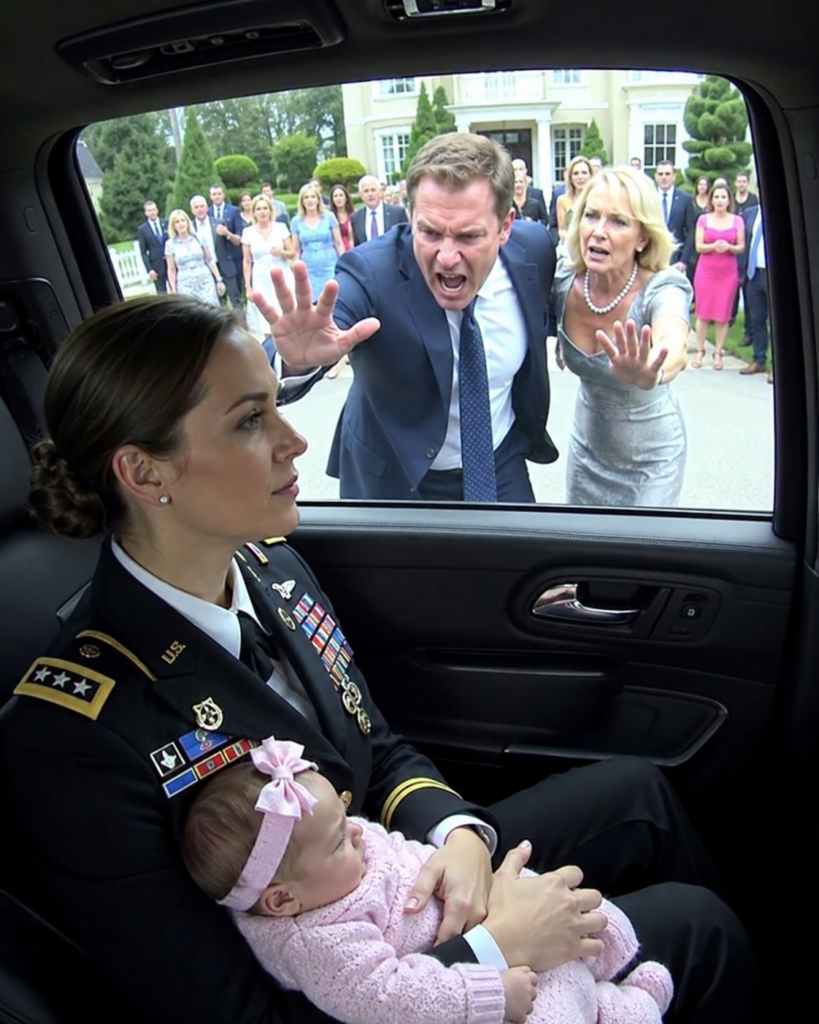
The white roses still crowded the silver vases in the sunroom, their petals beginning to curl at the edges. The crystal chandelier glittered above polished floors, and trays of untouched pastries sat beneath glass domes like evidence someone had forgotten to hide.
Outside, my father’s black sedan stopped behind Wesley’s car.
I stood in the foyer with June asleep against my chest, listening to footsteps gather beyond the carved double doors.
Wesley had offered to drive us, but I chose my own car.
It was not defiance for show. It was a boundary I needed him to see.
During the ride, he called twice, then texted once.
Please let me explain before everyone starts.
I did not answer. By then, explanations felt smaller than silence.
When I stepped from my car, the July heat pressed around me, thick with gardenias.
My father opened his door and rose slowly, tall, silver-haired, wearing a plain navy suit instead of a uniform, which somehow made him look more formidable.
Colonel Thomas Ellis had never needed volume to command a room.
He came around the sedan, studied my face, then looked at June. His expression softened in a way that still surprised me, no matter how many times I saw it.
“She slept?” he asked.
“For twenty minutes,” I said. “Then she remembered the world is inconvenient.”
The corner of his mouth lifted. He touched two fingers gently to June’s covered foot.
“Smart girl.”
Behind him, two people emerged from the car: a woman with a leather portfolio and a quiet man carrying a tablet.
I recognized the woman immediately.
Dana Mercer had served with my father years ago before becoming a family attorney whose calm manner could make powerful people check their posture.
The man was Captain Rafael Ortiz, my father’s former aide, now working in security consulting.
Wesley had said my father was bringing people. He had not said he was bringing witnesses who understood documentation, risk, and consequences.
“This is not an ambush,” my father said, reading my face. “It is a conversation with structure.”
“Margaret won’t appreciate structure,” I said.
“Then today may broaden her education.”
We went inside.
The butler, Mr. Hale, opened the door before we knocked. He was elderly, dignified, and clearly uncomfortable.
His gaze flicked to June’s pink cap, then to my father.
“Mrs. Pembroke asked that everyone assemble in the sunroom.”
“Thank you,” my father said.
Mr. Hale lowered his voice.
“Mrs. Pembroke also asked that phones be collected.”
A small laugh escaped me before I could stop it.
My father did not laugh.
“No,” he said simply.
Mr. Hale looked relieved not to argue.
“Very good, sir.”
He stepped aside, and the familiar marble hallway seemed longer than before.
Voices drifted from the sunroom, hushed and restless.
I caught fragments.
Overreaction. Embarrassing. Military people. Poor Wesley.
My father heard them too. He did not react.
Dana walked slightly behind me, while Captain Ortiz took in the angles of the room, not suspiciously, but attentively, as if every house told the truth if one knew where to look.
Wesley stood near the doorway when we entered.
His eyes found mine first, then June’s, then the people around me.
He looked as though he had spent the night aging.
“Nora,” he said quietly.
I nodded once.
Nearly everyone from the party had returned, though without champagne and laughter they seemed less impressive.
Cousins sat stiffly on cream sofas. Margaret’s daughters whispered near the windows. Wesley’s father, Charles Pembroke, stood beside the fireplace with one hand in his pocket and the other gripping the mantel.
Margaret occupied the center of the room in a pale blue dress, pearls at her throat, chin lifted as if the meeting were a performance she intended to win.
On the table before her sat the velvet box.
It was closed now, but I could still hear that small gold bell.
Charles spoke first.
“Nora, Colonel Ellis, thank you for coming.”
His voice carried a practiced politeness that belonged in boardrooms and charity galas.
“This has clearly become more serious than anyone intended.”
“It became serious when your wife reached toward my grandchild with a collar,” my father replied.
The room tightened.
Margaret gave a thin smile.
“Colonel, surely you understand family humor can sound harsh to outsiders.”
“I understand intent often reveals itself through repetition.”
He turned to me.
“Nora has endured similar remarks for years. Yesterday involved a five-week-old infant. That is not humor. That is escalation.”
Wesley flinched at the word endured.
I wondered if he had ever counted the incidents, or if love had made him lazy in the places where courage should have lived.
Margaret looked around as if expecting support.
A few cousins avoided her eyes.
“This is absurd,” she said. “A joke at a party is not a legal matter.”
Dana opened her portfolio.
“It may not need to become one, Mrs. Pembroke. That depends entirely on what your family chooses now.”
Margaret stared at her.
“And you are?”
“Dana Mercer. I represent Nora’s interests today.”
The room shifted again.
For the first time, Margaret seemed uncertain.
Not frightened, not yet, but surprised that I had arrived with more than hurt feelings.
Charles set his jaw.
“No one wants lawyers involved.”
“Then no one should create records worth preserving,” Dana said.
Her voice was mild enough to make the words land harder.
“Nora has not posted the video. She has not contacted anyone in the press. She has not made accusations beyond what happened in front of sixty guests. She came here because Charles requested a family meeting.”
She paused.
“That restraint should not be mistaken for weakness.”
The phrase settled into the room like dust in sunlight.
Margaret’s eyes narrowed at me.
“So this is what you wanted,” she said. “To humiliate me.”
June stirred, her tiny mouth searching in sleep.
I laid a hand against her back and felt my own breathing steady.
“No,” I said. “Yesterday, you had an audience. Today, I wanted accountability.”
“For a necklace?” she snapped.
“For a pattern.”
My voice did not shake.
“For telling me, repeatedly, that I was less than this family. For teaching everyone here that laughing at me was acceptable. For extending that lesson to my daughter.”
Wesley moved closer.
“Nora, I should have stopped it sooner.”
His words were quiet, but the room heard them.
Margaret turned on him.
“Do not start apologizing for being embarrassed by your wife’s dramatics.”
Wesley’s face reddened.
“I’m embarrassed by myself.”
That silenced her more completely than my refusal had.
He looked at me, and for a second I saw not the Pembroke heir, not the son trained to smooth over his mother’s moods, but the man who had held my hand through June’s delivery and cried when she first opened her eyes.
“I failed you both,” he said.
Something inside me ached, because I had wanted those words yesterday, before my father, before the attorney, before every cousin had to witness his awakening.
But late truth was still truth, and I did not know yet whether it could grow into repair.
Margaret recovered quickly.
“Wesley, you are tired.”
“I’m awake,” he said.
Charles looked from his son to his wife, then closed his eyes briefly.
When he opened them, his voice was quieter.
“Margaret, apologize.”
The command was simple, but it carried years of things unsaid.
Margaret laughed once.
“You cannot be serious.”
He was.
“I am very serious,” Charles said. “This family has survived scandals, mistakes, and grief, but I will not have my granddaughter introduced to the world as an object of contempt.”
Margaret’s lips parted.
“Your granddaughter?”
“Yes,” he said. “My granddaughter. Nora’s daughter. Wesley’s daughter. A Pembroke, an Ellis, and entirely herself.”
For a moment, no one moved.
I had never heard Charles speak about June that way.
At the hospital, he had sent flowers but claimed a finance committee meeting kept him away.
Now he looked at my baby with something like regret folded into tenderness.
Margaret’s face hardened.
“Everyone is acting as if I hurt the child.”
“You tried to label her,” my father said. “Children grow into the labels adults hang on them.”
He did not raise his voice, but his words seemed to reach places volume never could.
“My daughter has defended people who will never know her name. She has led under pressure you cannot imagine. You saw quietness and decided it was permission.”
Margaret looked away first.
It was small, almost invisible, but I saw it.
So did Charles.
So did Wesley.
Power shifted, not dramatically, but permanently.
Dana placed a single sheet on the table.
“Nora’s expectations are straightforward. No unsupervised contact with June until trust is rebuilt. No disparaging remarks about Nora’s background, service, family, or parenting. No gifts with degrading messages. No attempts to collect phones or control records during family gatherings. And yesterday’s item will be removed from the house.”
Margaret glanced at the velvet box as if it had betrayed her.
“You expect me to sign rules in my own home?”
“No,” I said. “I expect you to decide whether access to my child matters more than your pride.”
The sentence cost me more than it appeared to.
June was not a bargaining chip; she was a boundary.
Still, saying it aloud made my chest feel hollow.
Margaret looked at Wesley, waiting for him to rescue her.
He did not.
“Mom,” he said, “sign it.”
Her eyes shone then, though whether from anger or hurt I could not tell.
“You would choose her over me?”
Wesley’s shoulders dropped, as if the question had finally become too old to carry.
“I am choosing my wife and daughter. That should never have been presented as choosing against you.”
Several relatives looked down.
I wondered how many had been forced into similar choices over the years, smaller but just as exhausting.
Margaret picked up the sheet and read it with exaggerated slowness.
“This is punishment.”
“It is a map,” Dana said. “People who want peace usually appreciate maps.”
To my surprise, a laugh came from the corner.
It was Sophie, Wesley’s youngest cousin, a college student who had barely spoken at family functions.
She clapped a hand over her mouth, cheeks flushing.
Margaret glared.
“Something amusing?”
Sophie lowered her hand.
“Honestly? Yes. The map line was good.”
The tension cracked, not enough to disappear, but enough to let air into the room.
Margaret’s control had always depended on everyone pretending her cruelty was elegance.
Sophie’s small laugh revealed how tired they were of pretending.
Charles stepped forward and opened the velvet box.
Inside, the black collar rested against satin, absurdly tiny, its gold bell bright beneath the chandelier.
He picked it up, his expression unreadable, then handed it to Captain Ortiz.
“Please dispose of this.”
Margaret inhaled sharply.
“Charles.”
“No,” he said. “There will be no relics.”
Captain Ortiz took it without ceremony.
The bell jingled once as it left the box.
June stirred again, and I felt an irrational wish that she never remember any sound like it.
Wesley reached toward us, then stopped before touching my arm.
The restraint mattered.
“Can I hold her?” he asked.
Yesterday, I might have handed her over automatically.
Today, I looked at him for a long moment.
“Not yet,” I said softly.
Pain crossed his face, but he nodded.
“Okay.”
That single acceptance, without argument, was the first useful thing he had done since the party began to fracture.
Margaret signed eventually.
Her signature was sharp enough to tear the paper.
Dana witnessed it.
Charles signed too, though the rules were not addressed to him, and then Wesley added his name without being asked.
When he finished, he removed something from his jacket pocket: the apron Margaret had given me two Christmases earlier, folded into a square.
Know Your Rank, the embroidery said in cheerful red thread.
My throat tightened.
“I found it in the hall closet,” he said. “I kept telling myself it was harmless because you never complained. That was convenient, not true.”
He placed the apron beside the empty velvet box.
“I’m sorry,” he said again, but this time he did not aim the apology at the room.
It was for me, and perhaps for the woman I had been before I learned to translate dismissal into endurance.
Margaret stared at the apron as if it were more damning than the collar.
“You saved that?” she said.
“Nora saved it,” Wesley replied. “Probably because she was trying to survive us politely.”
The word us landed.
He did not separate himself from the family’s behavior.
I felt my anger shift shape.
It did not vanish.
It became something heavier and less hot, something I could carry without letting it carry me.
My father watched Wesley with guarded attention.
He had never disliked my husband, exactly, but he distrusted comfort when it excused cowardice.
“Words are a beginning,” he said.
Wesley met his eyes.
“I know.”
“Good,” my father said. “Because beginnings are easy.”
Margaret pushed back her chair.
“Are we finished being lectured?”
Charles looked tired.
“We are finished pretending nothing happened.”
She turned toward the windows, where the gardens shimmered in the heat.
“Wonderful. A revolution.”
No one answered.
That may have unsettled her more than argument.
For years, Margaret had turned every room into a stage by making others respond to her.
Silence denied her an audience.
Sophie crossed to me hesitantly.
“Nora,” she said, “I should have said something yesterday.”
Her voice trembled.
“I laughed because everyone laughed, and then I hated myself for it.”
I studied her young face, ashamed and earnest.
“Thank you for saying that.”
She swallowed.
“June is beautiful.”
I looked down at my daughter.
“She is.”
Sophie smiled faintly.
“She looks like she already knows things.”
“She does,” my father said, deadpan. “Mostly that adults are inefficient.”
Sophie laughed again, quieter this time, and even Charles’s mouth twitched.
The room began to dissolve into smaller conversations, awkward but real.
Some relatives approached to apologize.
Others escaped toward the terrace.
Margaret remained near the window, rigid as a statue.
Dana gathered the signed paper and slipped it into her portfolio.
“You handled yourself well,” she told me.
“I handled myself tired,” I said.
“Often the same thing,” she replied.
Captain Ortiz returned from the hall empty-handed.
“Disposed?” my father asked.
“Secured,” Ortiz said.
That word made my attention sharpen.
“Secured?”
Ortiz glanced at my father before answering.
“I placed it in an evidence bag in my car. Thought it might be wiser than throwing it away.”
Dana nodded approvingly.
“Good instinct.”
Margaret turned from the window.
“Evidence bag? This is grotesque.”
“It is precautionary,” Dana said. “There is a difference.”
Charles rubbed his forehead.
“Enough.”
But I noticed he did not ask Ortiz to discard it.
Something about the object had changed when he held it.
The collar was no longer a joke or prop.
It was a message with weight.
We might have left then, and perhaps Part Two of my life would have begun cleanly, with signatures and apologies and a careful drive home.
But houses like the Pembroke estate did not reveal all their secrets at once.
As Mr. Hale entered to clear the abandoned coffee cups, he hesitated beside the table.
His old hand hovered near the velvet box.
“Mrs. Pembroke,” he said, voice barely audible. “May I speak?”
Margaret’s gaze snapped to him.
“Not now.”
Charles looked at the butler.
“What is it, Hale?”
The old man’s face had gone pale.
Mr. Hale stood straighter, as if choosing between loyalty and conscience.
“That box,” he said. “It arrived with the morning deliveries yesterday. Mrs. Pembroke did not purchase it.”
The room went still again, but differently this time.
Margaret’s expression changed so quickly I almost missed it.
Not guilt.
Surprise.
“What are you talking about?” she demanded.
Hale swallowed.
“I set it in your dressing room with the note.”
“What note?” Charles asked.
Margaret’s eyes flicked toward the hall.
She knew of a note.
I saw it.
Wesley saw it too.
“Mom,” he said slowly. “What note?”
Margaret’s voice thinned.
“It was nothing.”
My father stepped forward, not aggressively, but with the quiet inevitability of weather.
“Mrs. Pembroke, where is it?”
“I threw it away.”
“When?”
She did not answer.
Charles turned to Mr. Hale.
“Do you remember what it said?”
The butler looked miserable.
“Only a little, sir. It was typed. It said something like, ‘Start with the child, and she will remember who opened the door.’”
A coldness spread through me that had nothing to do with humiliation.
June sighed in her sleep, her warm cheek against my collarbone.
Dana’s posture changed.
Captain Ortiz was already moving toward the hallway.
“Which dressing room?” he asked.
Hale pointed.
Margaret stepped in front of him.
“You cannot search my private rooms.”
Charles looked at her with disbelief.
“A message was sent to this house involving my granddaughter, and you hid it?”
“I handled it.”
“By using it?” Wesley asked.
His voice cracked.
Margaret’s composure faltered.
“I thought it was from one of the girls playing a joke. The collar was ridiculous. I made it ridiculous first.”
“You made my daughter the punchline,” I said. “To protect yourself from looking foolish?”
She opened her mouth, then closed it.
For once, no polished answer appeared.
Captain Ortiz returned with a small wastebasket lined in cream paper.
“May I?” he asked Charles.
Charles nodded.
Margaret said nothing.
Ortiz lifted out a torn envelope, then two pieces of a folded card.
Dana put on gloves from her portfolio, which told me she had expected some version of the unexpected.
She aligned the torn pieces on the table.
The message was short, typed in black ink, unsigned.
Beneath the sentence Hale had remembered was another line he had not seen.
My name was there.
Nora Ellis Pembroke was never meant to enter this family.
Ask Charles what he buried before Wesley was born.
My eyes lifted to Charles.
All color had drained from his face.
Wesley stared at his father as if the floor had shifted beneath him.
Margaret whispered, “Charles?”
My father’s expression became unreadable, which frightened me more than anger would have.
June woke then, blinking up at the chandelier, and the tiny sound she made seemed impossibly normal in a room suddenly crowded with the past.
Charles reached for the mantel to steady himself.
“Who sent that?” Wesley asked.
No one answered.
Outside, thunder rolled across the summer sky, though sunlight still burned through the windows.
Dana photographed the note.
Ortiz sealed it carefully.
Margaret sat down as if her knees had betrayed her.
Charles looked at me, then at Wesley, then finally at my father, and in his face I saw recognition of a danger older than yesterday’s cruelty.
My father spoke first.
“Charles,” he said, very quietly, “what did you bury before Wesley was born?”
Charles closed his eyes.
When he opened them, he looked at June.
“Not what,” he said.
“Who.”
PART 3
For several seconds, no one moved.
The word who seemed to hang above the sunroom, suspended beneath the chandelier with the dust and the scent of wilting roses. June had gone still against my chest, her tiny eyes open but unfocused, as if even she sensed that the room had shifted into a place where old secrets breathed.
Charles Pembroke looked older than he had a moment before.
Not tired. Not embarrassed.
Haunted.
Wesley stared at his father with a face I had never seen on him before. He looked like a man standing at the edge of a familiar room and realizing the floor beneath the rug was missing.
“What does that mean?” Wesley asked.
Charles did not answer.
Margaret gripped the arm of the chair beside her. Her pearls rested perfectly at her throat, her pale blue dress remained immaculate, but her expression had changed completely. The woman who had commanded the room only minutes earlier now looked as if someone had knocked on a locked door inside her memory.
“Charles,” she whispered again. “Tell me this is not about Eleanor.”
My father’s eyes sharpened.
Dana Mercer’s pen stopped moving.
Captain Ortiz looked from one face to another, absorbing every reaction without interrupting.
Wesley turned toward his mother.
“Who is Eleanor?”
Margaret pressed her lips together.
Charles lowered himself slowly into the nearest chair. The movement was careful, almost fragile. He rubbed one hand across his face, then looked at the torn note on the table.
“Nobody buried anyone,” he said at last. “Not in the way that sounds.”
“That is not an answer,” my father said.
Charles nodded once, as if accepting that.
“No,” he said. “It isn’t.”
Outside, thunder rolled again, closer this time. The light through the windows dimmed as clouds gathered over the garden. The estate, with all its polished marble and antique portraits, suddenly felt less like a home and more like a museum built over an unmarked cellar.
Wesley took a step toward his father.
“Dad, who is Eleanor?”
Charles looked at him, and pain moved across his face.
“My sister.”
The room absorbed the words in silence.
I had been married to Wesley for three years. I had attended holiday dinners, charity breakfasts, Sunday brunches, and the kind of family gatherings where people discussed ancestors as if they were investments. I knew the names of great-grandfathers who owned textile mills and great-aunts who donated wings to hospitals.
But I had never heard the name Eleanor Pembroke.
Wesley looked equally stunned.
“You had a sister?” he said.
Charles closed his eyes briefly.
“Yes.”
Margaret stood abruptly.
“This is not the place.”
Charles looked at her.
“It became the place the moment that note entered this house.”
Margaret’s jaw tightened, but she did not argue.
Sophie, still near the windows, folded her arms around herself. Her earlier courage seemed to tremble in the air. Several relatives exchanged glances, and I realized with a quiet chill that some of the older ones knew the name. Not all of them. But enough.
My father noticed too.
“When?” he asked.
Charles turned toward him.
“When what?”
“When did Eleanor disappear from the family record?”
Charles swallowed.
“Nineteen eighty-four.”
The year landed with the weight of a locked drawer opening.
Wesley shook his head slowly.
“I was born in eighty-seven.”
“I know,” Charles said.
“You never told me.”
“I know.”
A flicker of anger crossed Wesley’s face, but beneath it was something more wounded. There is a particular kind of grief that comes from learning you were raised inside an edited version of your own family. I saw it settle over him, and despite everything between us, I wanted to reach for his hand.
I didn’t.
But I wanted to.
Charles leaned forward, elbows on his knees, no longer the polished patriarch of the Pembroke family. He looked like a son who had once been very young and very afraid.
“Eleanor was two years younger than I was,” he said. “Brilliant. Stubborn. Funny in ways that got her into trouble. She hated the rules in this house. Hated the expectations, the dinners, the quiet agreements no one admitted making.”
Margaret looked toward the door, as if wishing the walls would release her.
“She was dramatic,” she said softly.
Charles turned on her, not with fury, but with exhaustion.
“She was eighteen.”
Margaret’s face closed.
Wesley’s voice was low.
“What happened to her?”
Charles reached for the torn note, then stopped before touching it.
“She fell in love with someone my parents considered unsuitable.”
For one strange moment, everyone in the room looked at me.
Not because I was Eleanor.
Because I was a reminder.
Working-class family. Military father. No inherited place at polished tables. The wrong kind of woman, according to people who measured worth in old silver and quiet obedience.
The recognition passed through the room like a current.
Charles saw it too. His eyes moved to mine, and his shame deepened.
“Nora,” he said, “this is not the same.”
I held June closer.
“Isn’t it?”
He looked away.
No one rushed to defend him.
That silence mattered.
Charles took a breath.
“His name was Daniel Reyes. He worked with horses at a property outside Asheville that my family owned at the time. Eleanor met him one summer. By autumn, she wanted to leave Charlotte and study art in Savannah. My parents said no. Daniel encouraged her to apply anyway.”
Sophie whispered, “Good for him.”
Margaret shot her a look, but it had less power now.
Wesley crouched slightly before his father, no longer caring about the others listening.
“Did she leave?”
Charles nodded.
“She tried.”
The word tried was a small door opening onto sorrow.
My father’s posture became stiller. It was something I had seen in briefing rooms, in hospital corridors, in every moment when emotion had to wait behind attention.
“What stopped her?” he asked.
“My father,” Charles said.
No one breathed loudly.
Charles’s voice roughened.
“He threatened to cut her off. That part everyone expected. But then he threatened Daniel. Not publicly. Not directly enough to prove. Just enough that Eleanor understood.”
“What kind of threat?” Wesley asked.
Charles looked at him for a long time.
“The kind rich men used to make without raising their voices.”
Wesley stood.
His hands curled at his sides, then loosened, as if he were trying not to let anger become the only thing he felt.
“And you knew?”
“I was twenty-two,” Charles said. “Home from college. Afraid of my father. Afraid of losing everything. Afraid of becoming the next disappointment.” His eyes glistened. “Yes. I knew.”
Margaret sat back down slowly.
Dana spoke gently.
“Mr. Pembroke, when the note says, ‘Ask Charles what he buried before Wesley was born,’ is it referring to Eleanor’s disappearance?”
Charles shook his head.
“Eleanor didn’t disappear.”
A quiet gasp came from one of the aunts near the sofa.
Charles looked toward her.
“She left.”
The aunt’s face crumpled, just slightly, with the expression of someone whose private suspicion had finally been given shape.
“She left with Daniel,” Charles continued. “Or she planned to. I drove her to the bus station.”
Wesley stared at him.
“You helped her?”
Charles nodded.
“It was the bravest thing I had ever done and the most cowardly, because I helped her leave and then came home and said nothing.”
The rain began then, soft at first, tapping against the sunroom windows.
Margaret’s eyes filled with tears she refused to let fall.
“She never wrote,” she said.
Charles looked at her.
“She wrote to me.”
Margaret went pale.
“What?”
“She wrote for almost a year.”
The room went colder.
Wesley took a step back, as if he could not decide whether to move closer or farther away from his father.
“You told everyone she never contacted you,” he said.
“I told everyone what my father instructed me to say.”
My father’s voice was careful.
“What happened after that year?”
Charles did not answer immediately.
He looked toward the garden. Rain dotted the glass, blurring the rows of hedges and white roses outside.
“Her letters changed,” he said. “At first she was happy. Poor, but happy. She and Daniel were married in a courthouse near Savannah. She painted street portraits. He worked at a marina. She wrote that they had very little money but more peace than she had ever known in this house.”
His voice broke on the word peace.
I looked down at June, at her small fingers opening and closing against the fabric of the wrap, and imagined a young woman writing letters to the brother who had helped her escape. A young woman believing blood might still mean sanctuary.
“Then?” Wesley asked.
Charles reached into his jacket pocket, fingers trembling.
From inside, he withdrew a small brass key on a worn ring.
Margaret stared at it.
“You kept it?”
“I couldn’t throw it away,” Charles said.
“What is that?” Wesley asked.
Charles held it in his palm.
“The key to Eleanor’s old desk.”
Margaret stood.
“No.”
The word was sharp, frightened.
Charles looked up at her.
“It is time.”
“No,” she said again. “Your father wanted those things gone.”
“My father has been dead for seventeen years.”
“And still,” Margaret said, voice shaking, “you let him live in this house.”
That sentence struck deeper than she seemed to intend. Charles flinched.
For the first time since I had known her, Margaret Pembroke looked not cruel, not commanding, but trapped by the very legacy she had spent her life enforcing. It did not excuse her. But it explained a shape I had mistaken for strength.
My father turned to me.
“Nora, do you want to stay?”
The question, simple and respectful, nearly undid me. All morning, people had discussed meetings, papers, notes, and secrets around me. My father gave me something no one else had.
Choice.
I looked at Wesley. He was watching me, not pleading, not assuming. Just waiting.
Then I looked at Charles.
“Does this have anything to do with my daughter?” I asked.
Charles’s gaze dropped to June.
“I don’t know.”
That was the only answer that could have kept me there.
“All right,” I said. “Then we open the desk.”
The desk was not in Margaret’s dressing room.
It was in the east wing, a section of the estate I had rarely entered. The hallway smelled faintly of lemon polish and old wood. Portraits watched us from gilded frames, generations of Pembrokes posed in dark suits and satin gowns, their painted eyes following us as if offended by the intrusion.
Mr. Hale led the way.
His steps were slow but certain.
“I dusted the room every Thursday for thirty-one years,” he said quietly. “Mrs. Pembroke never asked me to stop. She only asked me never to open anything.”
Margaret, walking behind Charles, whispered, “Hale.”
But there was no command left in it.
The room was smaller than I expected. Not a grand bedroom, not a formal sitting room, but a corner space with tall windows overlooking a magnolia tree. A faded blue rug lay beneath a white iron bed. A bookshelf held old novels, art books, and a row of ceramic birds. On the wall hung a framed watercolor of the estate gardens painted in loose, vivid strokes.
It was the first imperfectly beautiful thing I had ever seen in that house.
Wesley stepped inside slowly.
“This was here the whole time?”
Charles nodded.
“My mother locked it after Eleanor left. After she died, Margaret kept it as it was.”
Margaret stood at the threshold.
“I thought preserving it was respectful.”
Charles looked at her.
“Preserving is not the same as remembering.”
She said nothing.
The desk stood beneath the window, painted cream, chipped along the edges. Charles fitted the brass key into the lock. For a moment, his hand froze.
Wesley moved beside him.
“Do you want me to?”
Charles looked at his son, and something passed between them. Not forgiveness. Not yet. But an offer. A bridge no wider than a hand.
“Yes,” Charles said.
Together, father and son turned the key.
The drawer opened with a soft wooden scrape.
Inside were letters tied with faded green ribbon, a leather sketchbook, and a small sealed envelope with Charles’s name written across it in elegant, slanted handwriting.
Charles did not touch the envelope.
He stared at it as if it were alive.
Dana gently said, “That appears personal. You may want privacy.”
“No,” Charles said. “Privacy is how we got here.”
He lifted the envelope, broke the brittle seal, and unfolded the letter inside.
His eyes moved across the page. Halfway down, his breathing changed.
“Dad?” Wesley said.
Charles handed him the letter without a word.
Wesley read aloud, his voice unsteady.
“Charlie, if you are reading this, then either I finally found the courage to send it, or you found where I hid the copy. I am not angry with you for helping me leave. That is the best thing anyone in our family ever did for me.”
He paused and swallowed.
“I am angry that I need your help again.”
Rain streamed against the windows.
Wesley continued.
“Daniel is gone. Not dead. Gone. He left after things became too difficult, and I cannot pretend I was surprised. We were young, and love was real, but real does not always mean strong enough. I have a daughter now. Her name is Lila. She is six months old. She has my stubborn chin and your serious eyes, which seems unfair because you are not even here to help with night feedings.”
A startled sound came from Charles.
Margaret gripped the doorframe.
Wesley looked up.
“You have a niece.”
Charles sat heavily on the edge of the bed.
“I had a niece,” he whispered.
Dana’s expression softened but remained attentive.
Wesley looked back at the letter.
“I need to come home, but not to surrender. I need documents, money enough to start again, and a promise that Father will never decide my daughter belongs to him because of our name. I know you are afraid of him. I am too. But if there is any part of you that still remembers us hiding under the dining table during thunderstorms, please meet me at the old train depot on May 14.”
Wesley’s voice faded.
The room was silent except for rain.
“What happened on May 14?” I asked.
Charles covered his mouth with one hand.
“I didn’t go.”
The confession came out in a whisper.
Wesley lowered the letter.
“Why?”
Charles shook his head, eyes fixed on the floor.
“My father found the earlier letters. He knew she had written. He said if I went to meet her, he would make sure I never saw Margaret again.”
Margaret looked stricken.
“Charles…”
“We were engaged,” he said. “Your parents wanted the wedding. My father wanted the alliance. I was weak enough to believe losing you was the worst thing that could happen.”
Margaret covered her mouth.
“And Eleanor?” Wesley asked.
Charles looked up, tears finally spilling down his face.
“She waited at the depot. I know because she sent one final postcard three days later. It said, ‘I understand now.’ That was all.”
The words settled over us with unbearable gentleness.
I thought of the collar, the note, the way cruelty travels through families when no one stops to name its origin. I had believed Margaret invented her contempt for outsiders. Perhaps she had inherited it, polished it, and passed it forward because no one had taught her what courage looked like when it cost something.
Wesley folded the letter with trembling hands.
“She had a daughter,” he said. “Lila.”
My father, who had been standing near the bookshelf, reached carefully for one of the framed photographs tucked behind a ceramic bird. It showed a young woman sitting on the estate steps, laughing toward someone outside the frame. She had Charles’s eyes, Margaret’s elegance without the armor, and a baby tucked against her chest.
No.
Not Margaret’s elegance.
Her own.
My father turned the photograph over.
There was writing on the back.
Eleanor and Lila, summer 1985.
Wesley came closer to look. So did I.
June stirred against me, and for one strange, breathless moment, past and present seemed to overlap: two young mothers, two baby girls, two families deciding whether love was stronger than pride.
Charles stared at the photograph.
“I never saw this.”
Mr. Hale cleared his throat.
“I did.”
Everyone turned.
The butler’s face was pale, but his voice had steadied.
“She came here once.”
Charles stood.
“What?”
“Not to the front door,” Hale said. “To the garden gate. It was late. She had the baby with her. Your father was still alive. He saw her from the study window.”
Margaret whispered, “Oh, Hale.”
Charles looked shattered.
“When?”
“Autumn of eighty-five,” Hale said. “She asked for you. Your father told me you were not to be disturbed. He said she had made her choice.”
“And you obeyed him,” Charles said.
Hale bowed his head.
“I was a servant in his house, sir. Not a brave man.”
Charles’s anger rose, then collapsed under the weight of his own confession.
“No,” he said softly. “Neither was I.”
That honesty changed the room more than blame could have.
Wesley walked to the window and looked out at the rain. His shoulders shook once, barely. I knew him well enough to know he was fighting tears. I also knew him well enough to know he hated being seen doing it.
I crossed the room.
Not all the way.
Just close enough.
“Wesley,” I said.
He turned.
His eyes were bright.
“I thought I knew what family meant,” he said. “I thought it was showing up at dinners and keeping peace and not making things worse.”
I adjusted June against my chest.
“Sometimes keeping peace with the wrong thing makes everything worse.”
He nodded.
“I know that now.”
There was no dramatic music. No instant healing. Just rain, an old room, and a man beginning to understand that love without courage becomes another kind of silence.
He looked at June.
“I don’t want her to inherit this.”
“She won’t,” I said.
He looked at me then.
“Because of you.”
I held his gaze.
“Because of us, if you mean it.”
Something in him steadied.
“I mean it.”
Behind us, Charles picked up the bundle of letters tied with green ribbon.
“We need to find Lila,” he said.
Dana nodded.
“We can begin with the information in the letters. Locations, dates, names. Carefully. Respectfully.”
Margaret, who had been silent for a long time, finally stepped fully into the room.
Her eyes moved across Eleanor’s bed, the desk, the photograph, the letters. Her expression was difficult to read. Grief, guilt, fear, and something like recognition moved through it.
“I knew Eleanor,” she said quietly.
Charles turned.
“You never said.”
Margaret gave a small, humorless laugh.
“In this family, not saying things was considered loyalty.”
No one interrupted.
Margaret touched the back of the chair by the desk but did not sit.
“She was kind to me,” she said. “When I first came here, before our engagement was formal. I was terrified of your father. Everyone was. Eleanor saw it. She told me never to let the house teach me to disappear.”
Her voice broke slightly.
“And then she disappeared.”
The sentence opened something in the room.
Margaret looked at me.
“I became exactly the sort of woman she warned me about.”
I did not know what to say.
An apology spoken too late is still only a seed. It must be watered by changed behavior. Still, the fact that Margaret had spoken it in front of witnesses, without turning it into an excuse, mattered.
She looked at June.
“I am sorry for yesterday,” she said.
Not to the room.
Not to Wesley.
To me.
“To both of you.”
June blinked at her solemnly, as if weighing the sincerity of adults.
I nodded once.
“Thank you.”
It was not forgiveness. Not yet.
But it was a door left unlocked.
Captain Ortiz, who had been examining the sketchbook, suddenly stilled.
“Dana,” he said.
She crossed to him.
He laid the sketchbook open on the desk. The page showed a pencil drawing of the magnolia tree outside the window. Tucked between two pages was a folded piece of paper, much newer than the letters.
Dana unfolded it.
“This paper is not from the eighties,” she said.
My father stepped closer.
“What is it?”
Dana read silently first. Her face changed, just slightly.
Then she looked at me.
“Nora, this is addressed to you.”
My pulse moved hard in my throat.
“To me?”
She handed it over.
The handwriting was careful, slanted, unfamiliar.
Nora Ellis Pembroke,
If this reaches you, then the house has begun telling the truth. Do not trust the first apology. Do not fear the first confession. Eleanor’s daughter is alive, and she knows about June.
My hands tightened around the page.
Wesley moved beside me.
“What does it say?”
I read the final line aloud, because silence suddenly felt more dangerous than truth.
“She was never the only child they tried to erase.”
The room went absolutely still.
Then, from downstairs, the doorbell rang.
Once.
Twice.
Three times.
Mr. Hale looked toward the hallway, his face draining of color.
Charles whispered, “No one else was invited.”
The bell rang again.
June began to cry.